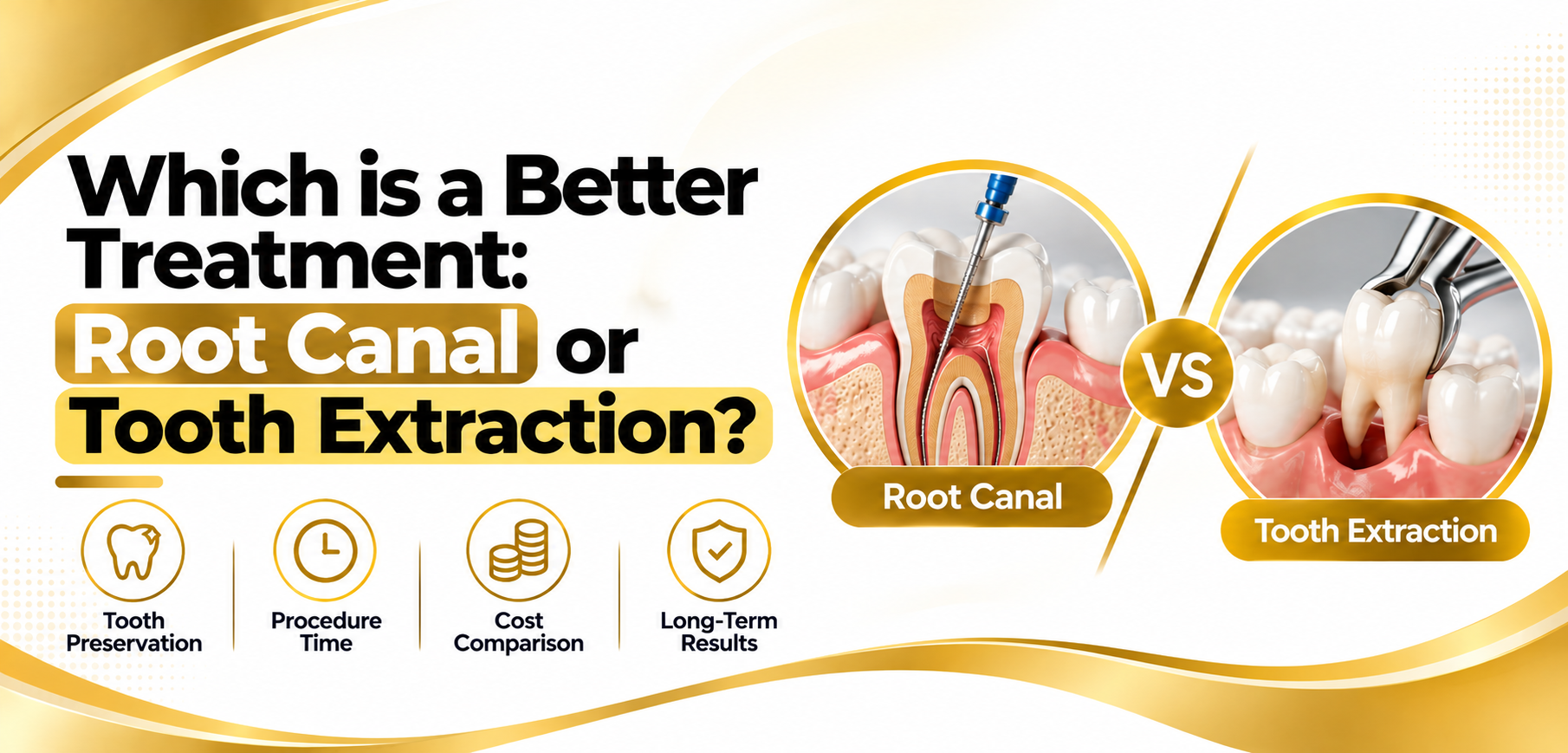
Which is a better treatment: Root Canal or Tooth Extraction?
Eating and drinking may be uncomfortable if you have painful tooth or deep cavities or damaged tooth. If a tooth is very damaged or infected, a dentist may suggest a tooth extraction or root canal treatment. The choice of the right option is dependent on the condition of tooth and the possibility of successful restoration.
Root Canal Treatment: What is it?Let's discuss about Root Canal Treatment
A root canal is a dental procedure to remove infection or inflammation from the inside of a tooth. The inner part, known as the dental pulp, has nerves and blood vessels. Cracks, deep cavities or injuries can affect the pulp and infect.
The dentist will clean and disinfect the root canals and seal them during the process, removing the infected pulp in the process. A dental crown might be necessary to preserve the remaining tooth structure.
Advantages of root canal treatment are:
- Preserving the natural tooth.
- Restoring chewing function.
- Alleviating the pain from pulp infection.
- Improvement in the need for tooth replacement.
A treated tooth will last many years if properly restored and cared for by the dentist.
So what is Tooth Extraction?
The extraction of tooth from the alveolar socket of the jaw bone is called tooth extraction. It can be required in cases where the tooth is severely damaged and cannot be restored, has a serious fracture or has lost substantial support due to advanced gum disease.
Once your tooth has been removed, your dentist will discuss with you aftercare instructions and whether a replacement will be necessary, including a dental implant, bridge or denture.
When to Recommend a Root Canal Treatment?
The pulp may be infected or irreparably inflamed but the tooth can still be saved with root canal treatment.
Common reasons include:
Deep tooth decay – When decay is in the pulp, treatment might be able to save the tooth.
Pain that lasts longer than usual: Any pain that is present or continuous for a longer period of time than usual may be a sign of pulp damage.
An infection within the tooth: Root canal therapy may help treat the infection by cleaning and sealing the tooth's root canals.
Dental injuries: If there is sufficient remaining healthy tooth structure, some damaged teeth can be saved.
The dentist can check the tooth and take dental X-rays to see how much damage has been done.
When Tooth Extraction is Necessary?
Tooth extraction might be indicated if there is no predictable chance of saving the tooth. These are often due to large decayed areas, some root fractures, advanced gum disease or past treatment that cannot be treated.
Some dentition or often dentition wisdom teeth also may need to be extracted. Your dentist should inform you if there are alternative means of saving your tooth.
Which Treatment is Worse for Pain?
The procedures are both usually carried out under local anaesthetic. Some tenderness or sensitivity will follow a root canal and last for a few days. The socket may become sore and swollen while it's healing after the extraction.
Recovery will depend on the complexity of the procedure as well as your condition. Both treatments are not necessarily more painful than each other.
So, how much does root canal treatment or tooth extraction cost?
It will depend on the tooth affected, the difficulty of the treatment and the type of restoration needed. The treatment may involve the treatment itself, the x-rays, and a filling or crown. Follow-up therapy may be necessary and a dental implant may be required.
The total cost may be higher if you need a dental implant or dental bridge after your extraction. Before you decide, seek advice from your dentist about the entire treatment plan.
Conclusion
Patients have to decide between a root canal and an extraction based on the condition of the tooth, and whether it can be successfully restored. Root canal treatment will keep a natural tooth, extraction may be needed if the damage is too severe to be fixed.
Talk to your dentist to get accurate information about your choices and maintain good oral health in the long term.